Global Governance and Mediation Take Center Stage on Day Two of Doha Forum 2025

07 December 2025 09:00 AM
Panelists examine shifting power dynamics, new mediation models, and the future of multilateralism
Day Two of Doha Forum 2025 concluded with a clear message: the global order is undergoing profound change, and governance, mediation, and diplomacy must adapt to meet the complexity of today’s crises. The Forum closed with a call for a collective commitment to justice in access to safety, education and healthcare from Her Highness Sheikha Moza bint Nasser, Chairperson of Qatar Foundation and Education Above All.
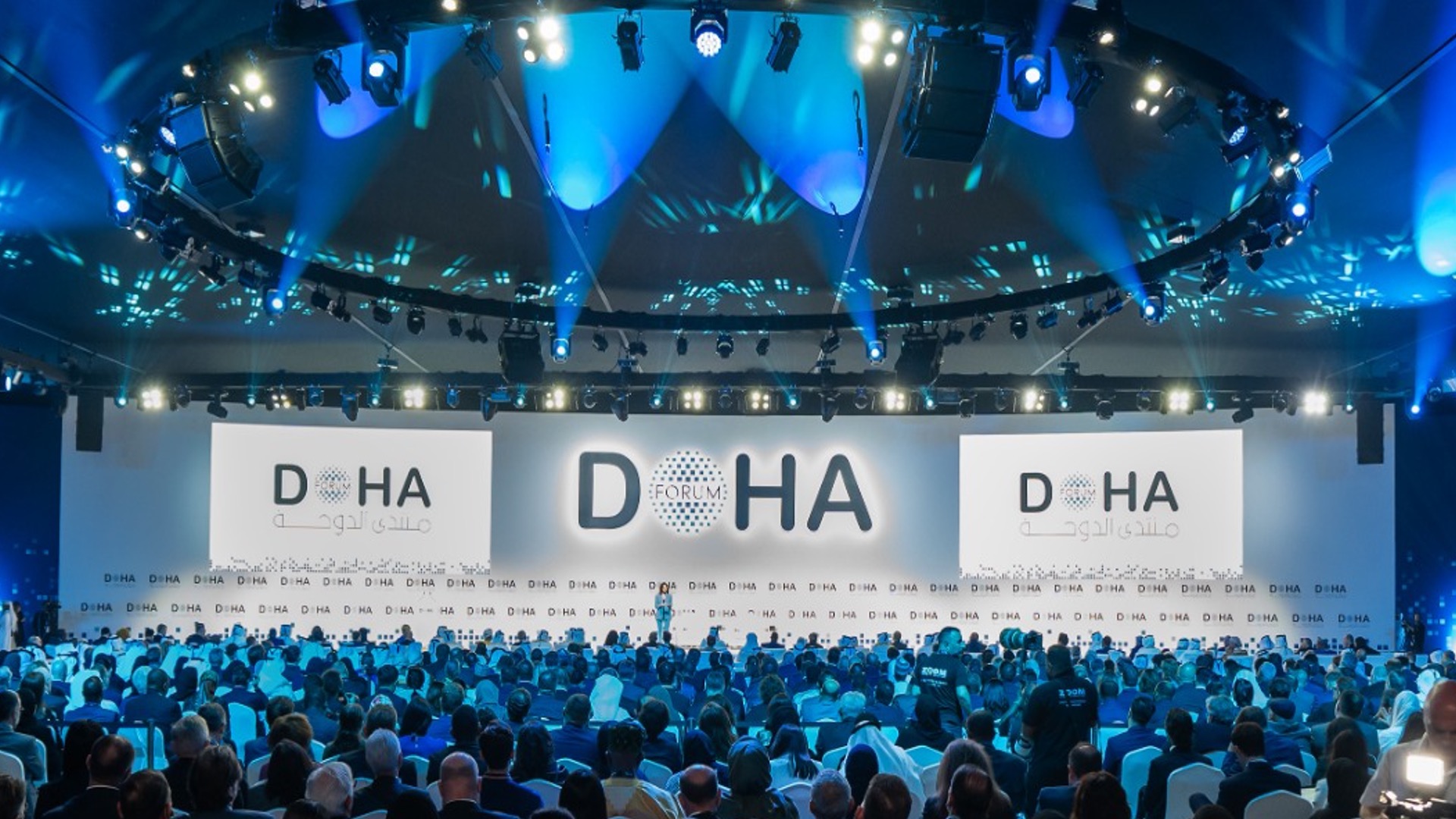
Across two days, more than 6,000 participants from over 150 countries — including more than 450 speakers — engaged in high-level discussions under the theme “Justice in Action: Beyond Promises to Progress.” Panels explored the role of middle powers, the future of AI-driven mediation, fractures in the rules-based international system, and the urgent need for inclusive, regionally grounded approaches to crisis resolution.
Held under the patronage of His Highness Sheikh Tamim bin Hamad Al Thani, Amir of the State of Qatar, the 23rd edition of Doha Forum convened global leaders, policymakers, diplomats, innovators, and experts to examine how governance, diplomacy, and accountability must evolve amid rapidly shifting geopolitical dynamics.
Day Two built on themes raised during the opening day - including justice, trust, and cooperation - while offering insights into emerging power realignments, humanitarian responsibilities, and the technologies reshaping international relations.
Day Two: Key Discussions and Highlights
1. Mediation, Conflict, and Post-Crisis Transitions
Syria’s Transition: One Year On
Regional and international experts assessed the evolving situation in Syria, emphasizing the complexity of stabilization efforts and the importance of coordinated, inclusive international engagement.
H.E. Asaad Hasan Al-Shaibani: Minister of Foreign Affairs, Syrian Arab Republic said, “When we talk about Syria today - especially over the past 12 months since December 8 - we can confidently speak of a success story built by Syrians themselves. They showed the world that the Syrian people are capable of moving beyond the past and looking toward the future with confidence and determination. We have restored the people’s trust, and the coming years will be marked by renewed enthusiasm.”
H.E. Dr. Mohammed bin Abdulaziz Al-Khulaifi: Minister of State, State of Qatar, asserted that Qatar had remained steadfast in its support of the Syrian people over 14 years of civil war: “We remained firm, believing strongly that this is the right path for the Syrians to write a country that is sovereign, that is prosperous and providing an opportunity for the people to live a better life.” He added that since the regime change Qatar’s relations with Syria have “never been stronger. We have been closely engaged across multiple sectors; energy, finance, and even at the international level. This is the right path forward, and it reflects what the Syrian people believe and deserve.”
Newsmaker Conversations
In an interview with prominent media figure Tucker Carlson, Sheikh Mohammed bin Abdulrahman bin Jassim Al Thani, Prime Minister and Minister of Foreign Affairs of Qatar stressed the importance of having “ a safe place for conflicted parties to achieve a deal, to end wars and to end conflicts,” adding “to have the mediator being bombed by one of the parties of the conflict, this has been unprecedented. It was not only an unethical move, it was throwing everything against the wall.”
His Excellency also highlighted the irony of regional players being asked to rebuild what Israel has destroyed in its war on Gaza, stating: “From our side as State of Qatar, we will continue supporting the Palestinian people, we will do whatever to alleviate the suffering but we are not the ones who are going to rebuild.”
In a conversation with Foreign Policy’s Editor-in-Chief Ravi Agrawal, Former US Secretary of State Hillary Clinton commented on the recently released US National Security Strategy: “This strategy signals a major US shift away from the alliances that have long defined its foreign policy which are key to the country's global influence.”
“There's a very strong indictment of Europe and, in particular, the openness of Europe and the composition of the population of Europe,” she noted. “And that to me is an unnecessary division between us and countries with whom we have a lot in common and a lot that is necessary to our security."
In a high-profile discussion with Gregg Carlstrom, the Middle East correspondent for the Economist, H.E. Dr. Nawaf Salama the Prime Minister of Lebanon reflected on reforms aimed at getting the Lebanese economy back on track, stating: “We are working on a draft law to enable depositors to have access to their block accounts before the end of this month. We are committed to holding parliament elections on schedule the same way we were able to hold the municipal elections on schedule. We are planning to hold these elections in May.”
2. Justice and Hope for the Future
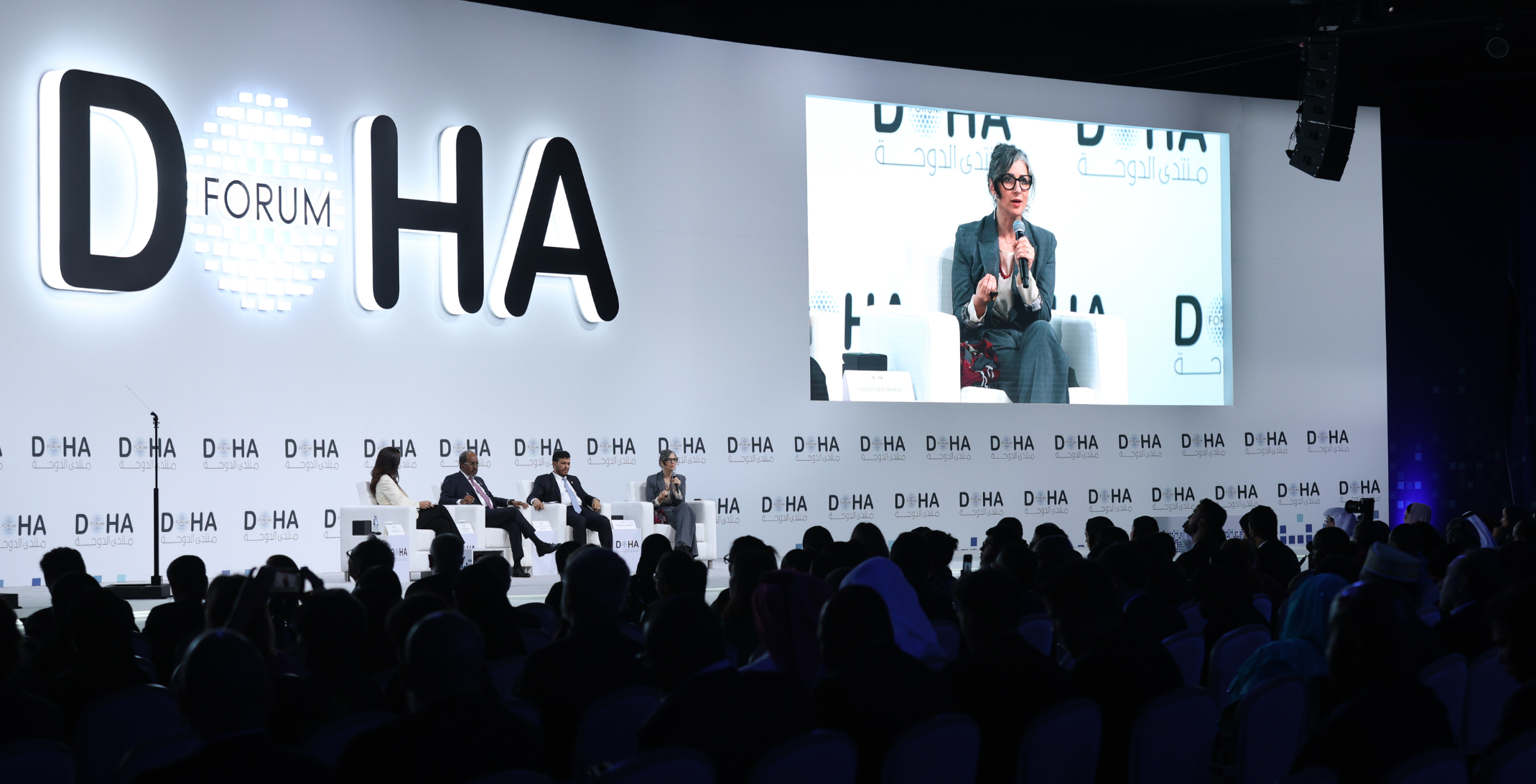
In the closing session A Future to Believe in, Rebuilding Trust Through Shared Action, Francesca Albanese, Special Rapporteur on the Occupied Palestinian Territories, United Nations, defended the need to follow international law, remarking: “It's not international law that has a problem, it's politics. It's politics that has completely lost its moral compass.”
She added that the events in Gaza had acted as a
global wake up call and pushed young people to rethink the global governance
system, saying: “We need to break this system in a peaceful way and how do we
do that in a respectful way? By following the rules of justice.”
3. Education, Inclusion & Human Development
Education as Justice in Times of Crisis
Education took centre stage in Day 2 with several sessions on education and justice, educational diplomacy and economic empowerment in Africa through investment in education. Speakers highlighted the severe barriers facing learners in places including Palestine and Syria, stressing the need for sustained international support and stronger protection of education systems during conflict and displacement.
H.E. John Dramani Mahama, President, Republic of Ghana, emphasized that his government was investing 20% of its GDP into education, saying: “Education is not a privilege, nor is it an afterthought of government policy, but an inherent right, a necessary condition for the dignity, empowerment and full realization of every citizen.”
H.E. Hind Kabawat, Syrian Minister for Social Affairs, Syrian Arab Republic, added: “If you ask any child, what is justice for you, they never mention that I want to take somebody to court…all they want is school.”
H.E. Humza Yousaf, Member of the Scottish Parliament (MSP), Scotland, stated: “We don't live in an era of accountability. We live in an era of complicity, where the world has turned on its head, where those who oppose a genocide like Francesca, they get sanctioned, and the ones who are complicit in the genocide get rewarded with money and with arms.
4. Technology, Climate & Economic Transformation
Speakers throughout the day examined the governance challenges emerging from rapid technological and environmental change - including AI regulation, cybersecurity cooperation, climate action in the Global South, and new models of economic empowerment.
Across these sessions, participants called for renewed
trust in international cooperation and the design of systems capable of
addressing 21st-century risks.
In the session “Mediation in the Age of AI: New Tools, New Approaches”, Izumi
Nakamitsu, Under-Secretary-General and High Representative for Disarmament
Affairs, United Nations Office for Disarmament Affairs, said: “We really
need to achieve an in-depth understanding of how technology is impacting the
conflict landscape. Not just hate speech in general but there is a fundamental
shift affecting social cohesion. The way AI is designed and information is
collected - all of this has an enormous effect on the conflict landscape.”
Helena Puig Larrauri, Co-founder & Strategy Lead , Build Up, suggested AI agents can be used as a place where conflict parties can challenge their beliefs by asking questions they can’t ask in person, adding: “It’s not that the truth is being eroded [by technology] but it is being fragmented. This fragmentation of truth is playing a role in Gaza, Ukraine, and Sudan.”
Doha Forum is a global platform for dialogue, bringing together world leaders, policymakers, business executives, civil society representatives, and thought leaders to exchange ideas and drive solutions to the most pressing challenges of our time. Full recordings of sessions can be found on the Forum’s official YouTube channel.